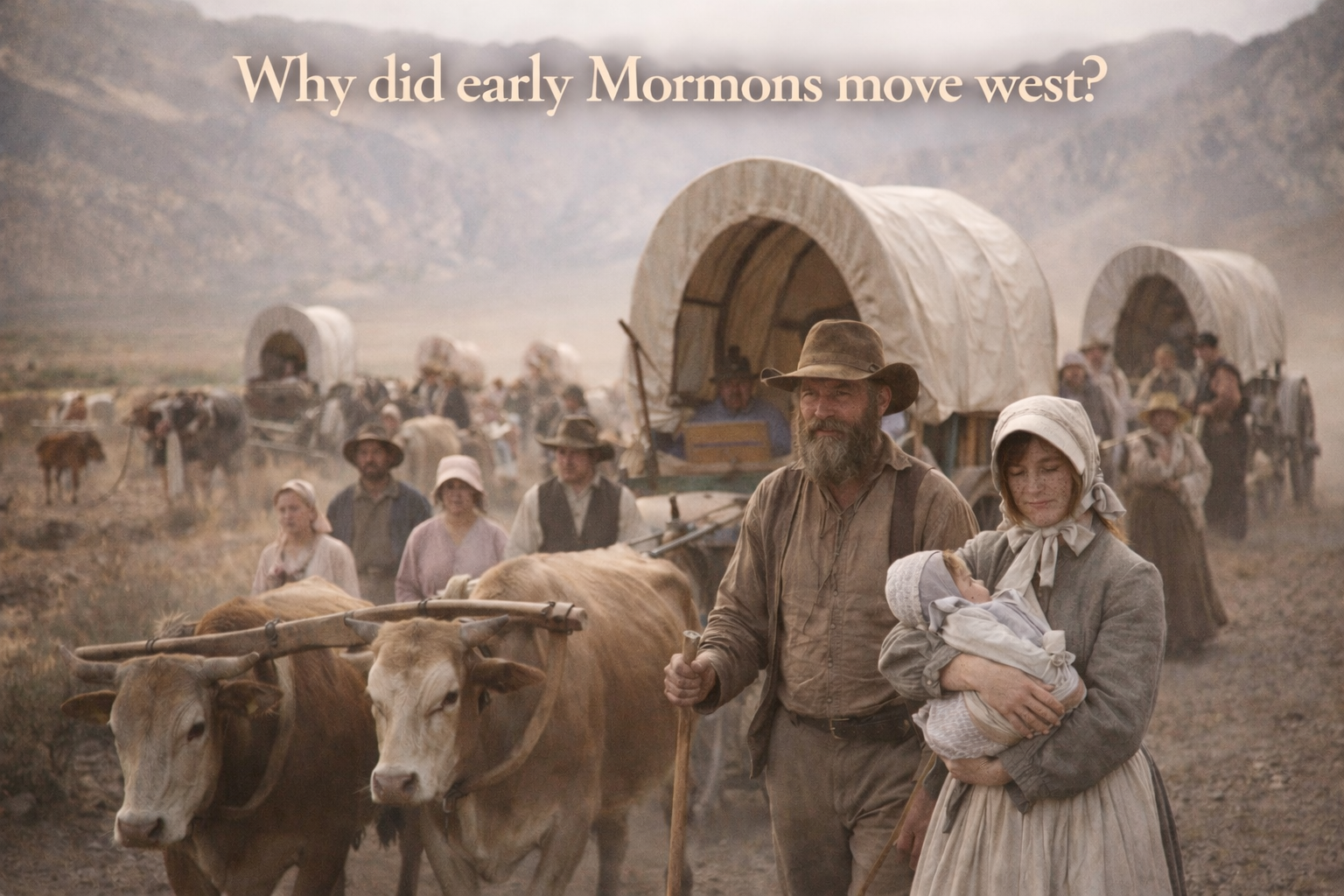
The westward migration of early members of The Church of Jesus Christ of Latter-day Saints is one of the most dramatic religious movements in American history. Tens of thousands of men, women, and children left established homes, crossed vast wilderness, and endured extraordinary hardship to settle in an unfamiliar land. This migration was not driven by adventure, wealth, or political ambition. It was driven by faith, survival, and a determination to worship God freely.
Early Latter-day Saints moved west primarily because they faced intense persecution, legal pressure, and violence wherever they attempted to settle in the eastern and midwestern United States. Repeatedly expelled from their homes, they searched for a place where they could live their religion without fear of attack or forced removal.
For Latter-day Saints, the westward journey is more than a historical episode. It is a symbol of sacrifice, covenant loyalty, community, and trust in divine guidance. The story of the pioneers continues to shape Latter-day Saint identity and belief today.
Persecution in the Eastern United States
From its beginnings in the 1830s, the Church encountered hostility and misunderstanding. New religious beliefs, claims of modern revelation, rapid conversion growth, and strong community bonds often alarmed surrounding populations.
In several states, fear turned into organized opposition, leading to harassment, violence, and expulsion.
Early Hostility in New York and Ohio
Joseph Smith organized the Church in New York, where skepticism and mockery were common. As converts gathered in Ohio, tensions increased. Economic competition, political influence, and religious differences created suspicion among neighbors.
While Ohio did not see the worst violence, it became clear that permanent peace would be difficult to maintain.
Missouri: Conflict and Expulsion
Missouri was intended to be a gathering place for the Saints. Instead, it became the site of some of the most severe persecution in American religious history.
Tensions escalated into armed conflict, arrests, destruction of property, and ultimately an executive order from the governor of Missouri declaring that Mormons must be expelled or exterminated. Entire communities were driven from their homes under threat of death.
Violence and Legal Pressure
Latter-day Saints were often denied legal protection. Courts failed to prosecute crimes against them, while Church members themselves were arrested or imprisoned.
Homes were burned, crops destroyed, and families forced to flee with little warning.
Illinois and the Rise of Nauvoo
After expulsion from Missouri, the Saints regrouped in Illinois and founded the city of Nauvoo. For a time, Nauvoo prospered and offered relative peace.
However, as the city grew rapidly, old patterns returned. Political fear, religious opposition, and internal dissent led to renewed conflict. Joseph Smith was arrested and murdered in 1844 while under state custody.
The murder of Joseph Smith convinced many members that peaceful coexistence was no longer possible.
The Search for Religious Freedom
After years of expulsion, early Latter-day Saints concluded that survival required distance. They needed land where they could govern themselves, worship freely, and build communities without constant interference.
Religious freedom was the central motivation—not isolation for its own sake, but safety and autonomy.
A Place to Worship in Peace
The Saints did not seek to abandon society or reject America. They sought a place where they could practice their faith openly without mobs, arrests, or forced removals.
Freedom to worship meant freedom to build temples, organize congregations, and live religious principles without fear.
Building Zion
Many early members believed they were commanded to build Zion—a community centered on Jesus Christ, cooperation, moral living, and mutual care.
Repeated expulsions made it impossible to fulfill this vision in the East.
Leadership and Divine Guidance
After Joseph Smith’s death, leadership passed to Brigham Young and the Quorum of the Twelve Apostles. Brigham Young became the central figure in directing the migration west.
Latter-day Saints believe this leadership was guided by revelation, prayer, and divine inspiration.
Brigham Young’s Role
Brigham Young organized the exodus from Nauvoo with remarkable efficiency. He coordinated wagon companies, supplies, routes, and timing to move thousands of people safely.
Members trusted his leadership not merely because of organizational skill, but because they believed God was guiding him.
Leaving the United States
The destination chosen—the Salt Lake Valley—was then part of Mexico. This was intentional. Leaving U.S. jurisdiction temporarily reduced the likelihood of legal persecution and military intervention.
The Decision to Go West
The choice to leave was not easy. Families abandoned homes, farms, businesses, and graves of loved ones. Many sold property at extreme loss or left it behind entirely.
Despite uncertainty, most believed remaining meant continued violence.
The Journey West
The journey itself was one of the most difficult mass migrations in American history. From Nauvoo, the Saints crossed Iowa, wintered in makeshift camps, and then traveled across the Great Plains and Rocky Mountains.
Wagon Companies
Most traveled in organized wagon companies, pulling supplies across thousands of miles. The journey took months and required constant planning.
Handcart Companies
Some poorer members traveled using handcarts, pulling their belongings by hand. While inspiring stories of faith emerged from these groups, many suffered greatly from hunger, exposure, and exhaustion.
Weather, Disease, and Death
Pioneers faced freezing winters, scorching summers, illness, accidents, and death. Graves dotted the trail.
Despite suffering, journals frequently express faith, prayer, and reliance on God.
Sacrifice and Endurance
The journey tested physical and spiritual limits. Faith sustained many who otherwise would not have survived.
Community Cooperation
Survival depended on cooperation. Members shared food, cared for the sick, buried the dead, and supported one another through grief and hardship.
Faith as the Driving Force
For many pioneers, the journey became a spiritual refining process. Hardship deepened reliance on God and strengthened community bonds.
Many later testified that despite suffering, they would make the same choice again.
Arrival in the Salt Lake Valley
In 1847, the first pioneer company entered the Salt Lake Valley. Brigham Young reportedly declared it the right place.
The valley was remote, arid, and seemingly inhospitable. Yet it offered isolation and opportunity.
Establishing a New Home
Upon arrival, the Saints immediately began building. They constructed homes, planted crops, dug irrigation canals, and organized governance.
Irrigation and Agriculture
The desert environment required innovation. Cooperative irrigation systems transformed dry land into productive farms.
City Planning and Order
Settlements were carefully planned, with streets, public spaces, schools, and meetinghouses.
Self-Reliance
Distance from supply centers required self-sufficiency. Communities learned to produce food, clothing, tools, and goods locally.
Expansion Throughout the West
From Salt Lake City, Latter-day Saints established hundreds of settlements across the western United States and beyond, including Utah, Arizona, Idaho, Nevada, and parts of Canada and Mexico.
These settlements supported trade routes, agriculture, and regional development.
Relationship With the United States
Eventually, U.S. borders expanded west, bringing the Saints back under federal authority. While conflict continued at times, large-scale expulsions ended.
Utah later became a U.S. territory and then a state.
Common Misunderstandings
A common misunderstanding is that early Mormons moved west to isolate themselves permanently. In reality, they expected eventual reintegration once peace was possible.
Another misunderstanding is that migration was driven by political rebellion or economic ambition. Historical records consistently show religious survival as the primary motivation.
Some believe the move was unnecessary. Latter-day Saints point to repeated expulsions and violence as evidence that remaining was not viable.
Why This History Matters to Latter-day Saints
The pioneer experience shapes modern Latter-day Saint identity. It reinforces values of sacrifice, faith, perseverance, and trust in God.
Pioneer stories are remembered not to glorify suffering, but to honor commitment to religious freedom.
Pioneer Legacy and Modern Faith
Today, members see parallels between pioneer sacrifice and modern discipleship. While circumstances differ, faith still requires courage, endurance, and willingness to follow God.
The westward migration is viewed as a testimony that God sustains those who act in faith.
The Westward Move and Jesus Christ
For Latter-day Saints, the journey west was ultimately about following Jesus Christ. They believed He led them away from danger and toward a place where His church could grow.
Their sacrifices are seen as expressions of devotion to Him.
Conclusion
Early Latter-day Saints moved west because persecution made peaceful worship impossible in the East. Driven by faith, guided by leadership they believed was inspired, and sustained by community, they undertook one of the most challenging migrations in American history.
The journey represents a profound commitment to religious freedom, covenant loyalty, and trust in God. For believers, it stands as enduring evidence that faith often requires sacrifice—and that God honors those who follow Him despite uncertainty.
Sources
The Church of Jesus Christ of Latter-day Saints – Gospel Topics: Pioneer History
https://www.churchofjesuschrist.org
Church News – Pioneer Migration
https://www.thechurchnews.com
Joseph Smith Papers – Nauvoo and Migration Context
https://www.josephsmithpapers.org
BYU Studies – Mormon Migration
https://byustudies.byu.edu