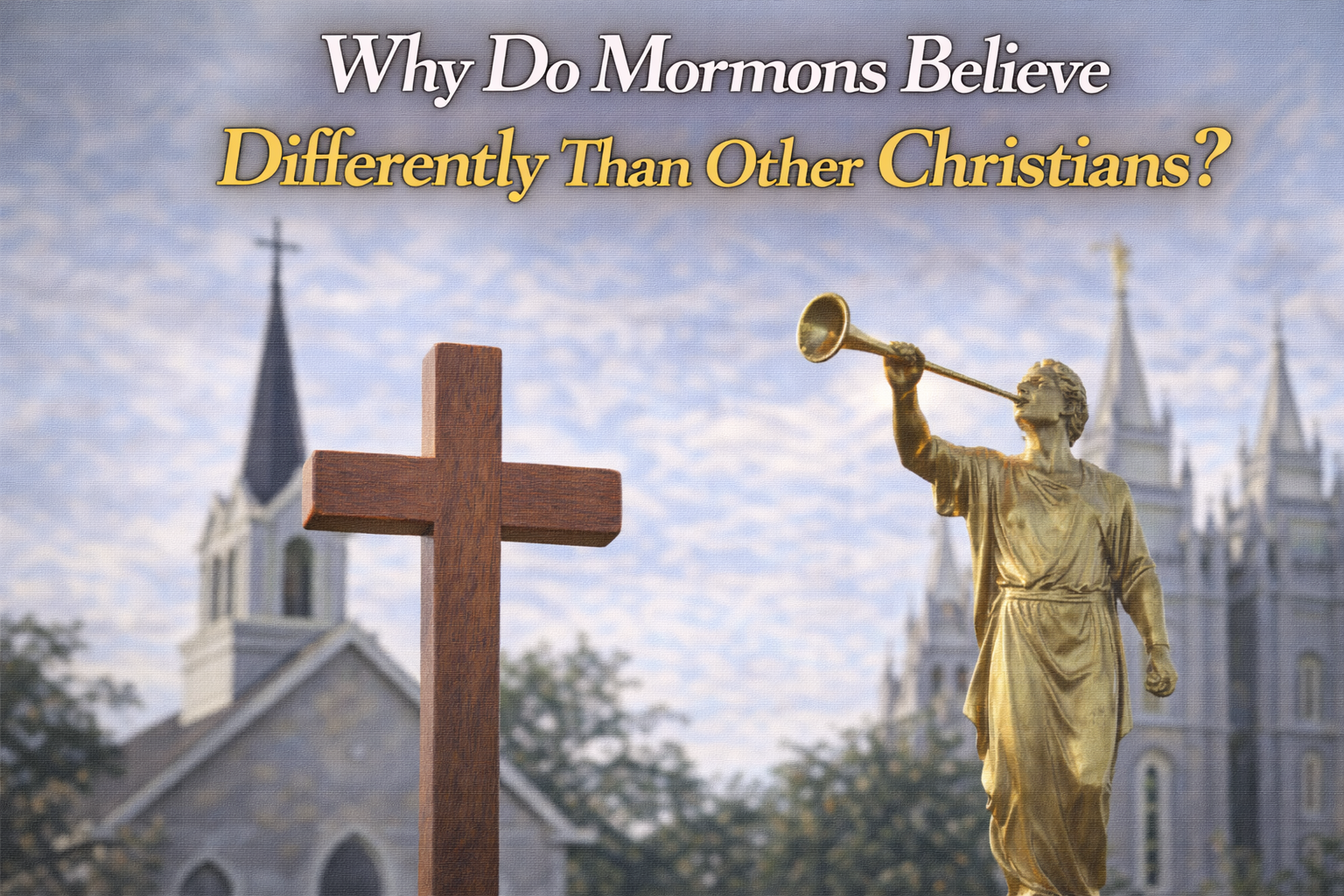
To many people, Christianity appears unified on the surface. Churches read the Bible, preach about Jesus Christ, and emphasize faith, prayer, and moral living. Yet when someone encounters Latter-day Saints for the first time, it often becomes clear that their beliefs sound different from those of many other Christian traditions. These differences can raise questions: Why do Mormons interpret scripture differently? Why do they emphasize modern prophets and additional revelation? Why don’t they simply follow the same creeds and doctrines accepted by most Christians?
Latter-day Saints believe differently than many other Christians because they approach the gospel of Jesus Christ through the lens of restoration rather than historical development alone. They believe that after the time of the apostles, Christianity preserved many essential truths but lost divine authority and certain teachings through centuries of theological debate, cultural influence, and institutional change. Because of this, they believe God restored His original church rather than reforming existing traditions.
These differences are not meant to reject Christianity or diminish the faith of others. On the contrary, Latter-day Saints see themselves as deeply Christian. Their beliefs are intended to explain why their theology may sound unfamiliar, while still affirming devotion to Jesus Christ as Savior and Redeemer.
Understanding why Latter-day Saints believe differently requires exploring how they understand authority, revelation, scripture, salvation, and God’s ongoing relationship with humanity.
Restoration Versus Tradition
One of the most fundamental differences between Latter-day Saints and other Christian traditions lies in how doctrine is understood to have developed over time. Most Christian denominations trace their theology through centuries of creeds, councils, and theological reflection. These traditions emphasize continuity through historical interpretation and institutional authority.
Latter-day Saints, however, believe that after the deaths of the apostles, the church Jesus Christ established lost direct guidance through revelation. Without apostles authorized to receive revelation for the entire church, doctrine became shaped increasingly by debate, philosophy, and political influence rather than divine instruction.
As a result, Latter-day Saints believe restoration was necessary.
Restoration, Not Reformation
Latter-day Saints do not believe Christianity merely needed reform. Reformation implies correcting human error within an existing structure. Restoration, by contrast, means God Himself reestablished His church through divine revelation.
According to Latter-day Saint belief, restoration involved the return of priesthood authority, original doctrine, sacred ordinances, and prophetic leadership. This is why they emphasize modern prophets and new scripture rather than relying solely on historical tradition.
Doctrine, in this view, comes from God speaking to humanity, not from consensus formed over centuries.
Authority Matters
For Latter-day Saints, truth is inseparable from divine authority. Interpretation alone is not enough. They believe Jesus Christ gave authority to His apostles, and that authority must exist today for ordinances and doctrine to be fully valid.
This focus on authority explains why Latter-day Saints do not rely on councils or creeds as final arbiters of truth. Authority must be restored by God, not reconstructed by human reasoning.
Continuing Revelation
Another major difference between Latter-day Saints and many other Christians is belief in continuing revelation. Most Christian traditions hold that public revelation ended with the Bible, and that God no longer reveals new doctrine to the church as a whole.
Latter-day Saints believe this idea conflicts with belief in a living God.
They believe God continues to speak, guide, and instruct His people through prophets, just as He did in biblical times.
A Living Church
Latter-day Saints often describe their church as a living church led by a living God. If God is active and personal, they reason, He must be able to guide His church in the present, not only in the past.
This belief allows doctrine to be clarified, corrected, and applied as circumstances change, while still remaining anchored in eternal principles.
A living church requires living guidance.
Guidance for Modern Times
Modern life presents challenges unknown to the ancient world. Latter-day Saints believe continuing revelation allows God to address issues such as global church growth, social change, technology, and moral complexity.
Rather than seeing revelation as adding new truths arbitrarily, they see it as God applying eternal truths to new situations.
This belief explains why some teachings may develop over time while core doctrine remains stable.
Additional Scripture
Another significant difference is belief in additional scripture beyond the Bible. Latter-day Saints believe God has revealed scripture in other times and places, including the Book of Mormon and modern revelations.
These scriptures are not viewed as replacements for the Bible, but as complementary witnesses of Jesus Christ.
Most other Christian traditions believe the biblical canon is closed.
Multiple Witnesses of Christ
Latter-day Saints believe truth is strengthened by multiple witnesses. Just as the Bible contains four Gospels testifying of Christ, additional scripture is seen as reinforcing that testimony.
They believe God would not limit His word to one volume or one culture if His purpose is to reach all humanity.
Additional scripture, in this view, reflects abundance rather than insufficiency.
View of God
One of the most noticeable theological differences concerns the nature of God. Most Christian traditions rely on creeds developed in the early centuries of Christianity to define God as a single being expressed in three persons.
Latter-day Saints, by contrast, believe God the Father and Jesus Christ are distinct beings united in purpose, will, and love. This belief is based on their reading of scripture and modern revelation rather than later philosophical formulations.
They believe biblical language describing God is often more literal than symbolic.
Biblical Language Taken Literally
When scripture describes Jesus praying to the Father, being sent by the Father, or standing at God’s right hand, Latter-day Saints interpret these passages more literally.
They believe early Christians understood God in more relational and embodied terms, and that later philosophical interpretations introduced ideas not explicitly found in scripture.
This approach leads to a different understanding of God’s nature while still affirming His divinity.
Priesthood Authority
Another key difference is belief in restored priesthood authority. Latter-day Saints believe ordinances such as baptism require divine authorization to be eternally binding.
Many Christian traditions emphasize faith alone or symbolic ordinances without institutional authority.
For Latter-day Saints, authority matters because ordinances are believed to have eternal consequences.
Authority and Ordinances
Priesthood authority is believed to be passed through ordination by those who already hold it, tracing back to Jesus Christ.
Without this authority, ordinances may be meaningful expressions of faith, but they are not believed to be divinely binding beyond mortal life.
This belief shapes how Latter-day Saints view baptism, confirmation, and other sacred rites.
Eternal Perspective on Salvation
Latter-day Saints also differ in how they understand salvation. While many Christians emphasize a single moment of conversion or justification, Latter-day Saints view salvation as a lifelong and eternal process.
Salvation involves grace, faith, covenants, and personal growth over time.
Rather than focusing solely on rescue from sin, they emphasize transformation into Christlike beings.
Grace and Growth
Grace is central to Latter-day Saint belief, but it is understood as empowering growth rather than replacing effort. Individuals are saved through Christ’s grace as they learn, repent, and progress.
This view broadens the purpose of mortal life, framing it as a time of preparation, learning, and spiritual development.
Salvation is not merely an event, but a journey.
Respect for Other Christians
Despite these differences, Latter-day Saints emphasize respect for other Christians. They believe truth, goodness, and sincere devotion to Christ exist throughout Christianity.
Differences are understood as theological rather than personal.
Latter-day Saints do not believe they are the only people loved by God or capable of righteousness.
Shared Faith in Christ
Jesus Christ remains the central figure of all Christian belief. Latter-day Saints affirm His divinity, atonement, resurrection, and role as Savior.
This shared faith creates common ground even amid theological differences.
Members are encouraged to build relationships, engage in dialogue, and cooperate with other Christians in service and moral efforts.
Common Misunderstandings
A common misunderstanding is that Latter-day Saints reject Christianity. They consider themselves devoted followers of Jesus Christ.
Another misunderstanding is that differences imply hostility or judgment. Church teachings emphasize humility, kindness, and mutual respect.
Some assume differences are arbitrary or cultural. Latter-day Saints believe they arise from restored doctrine and revelation, not preference.
Why This Belief Matters
Believing differently shapes worship, doctrine, and daily religious practice. For Latter-day Saints, restored beliefs provide clarity, purpose, and confidence in God’s ongoing guidance.
These differences reflect faith in a God who continues to speak, guide, and restore truth according to His will.
Ultimately, Latter-day Saints believe their differences testify not of division, but of a living relationship between God and humanity—one that did not end in ancient times and continues today through Jesus Christ.
Sources
The Church of Jesus Christ of Latter-day Saints – Gospel Topics: Restoration
https://www.churchofjesuschrist.org
Doctrine and Covenants Central – Restoration Doctrine
https://doctrineandcovenantscentral.org
Scripture Central – Restoration and Theology
https://scripturecentral.org