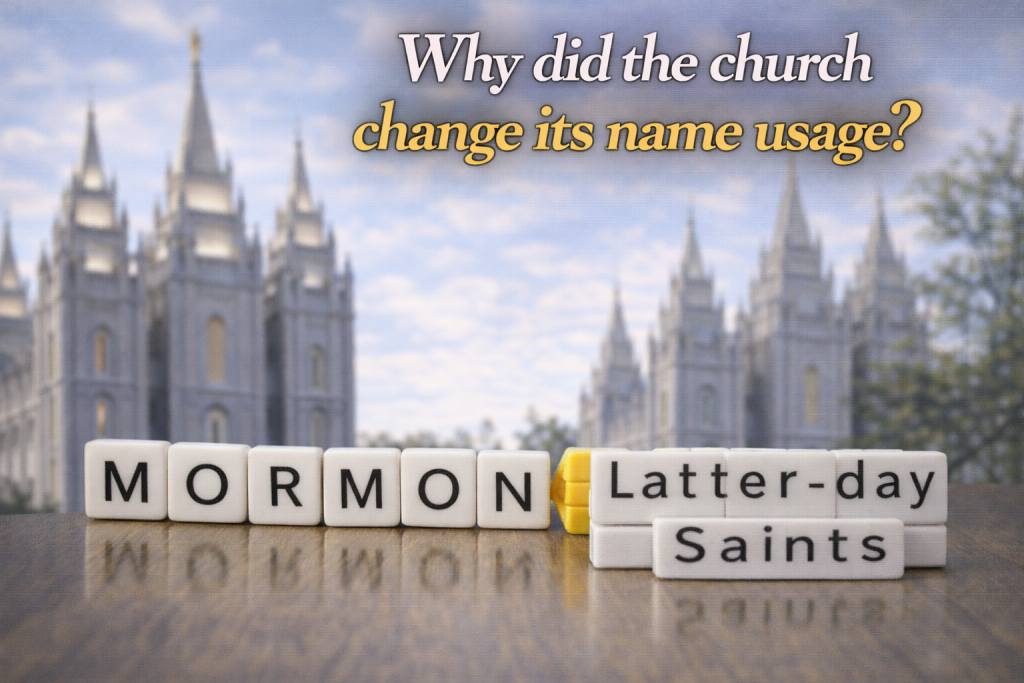
Few religious nicknames are as widely recognized as the word “Mormon.” For many people around the world, the term immediately brings to mind missionaries, family-centered values, or a distinct American-born faith. Yet the nickname also raises questions. Where did it come from? Why did it become so common? And if members of the Church emphasize Jesus Christ, why are they associated with a name that does not explicitly reference Him?
Latter-day Saints are often called “Mormons” because of their belief in the Book of Mormon, a volume of scripture they regard as another testament of Jesus Christ. The nickname did not originate from within the Church itself, but emerged in the early nineteenth century as a label used by outsiders trying to identify a new and unfamiliar religious movement.
Over time, “Mormon” became deeply embedded in public language, media, and culture. Even as the Church continued to use its full and formal name, the nickname persisted as a convenient shorthand. Today, understanding why Latter-day Saints are called “Mormons” requires examining history, language, identity, and the Church’s ongoing effort to clarify what it believes and how it wishes to be understood.
Origin of the Term “Mormon”
The word “Mormon” comes directly from the Book of Mormon, a book of scripture that Latter-day Saints believe is an ancient record of God’s dealings with people in the Americas. According to Church belief, the book was translated by Joseph Smith in the 1820s and published in 1830.
Early observers and critics of the new church quickly associated its members with this additional scripture. Because belief in the Book of Mormon set them apart from other Christian groups, outsiders began referring to Church members as “Mormons.”
The term was not originally chosen by Church leaders as an official designation. Instead, it emerged organically as a way for others to label a growing and unfamiliar religious community.
A Name Given by Outsiders
In its earliest usage, “Mormon” functioned as an external label rather than a self-chosen identity. Newspapers, critics, and neighbors used the term to distinguish members of the Church from other Christian groups.
In many cases, the nickname carried negative or mocking connotations, especially during periods of persecution and social tension in the nineteenth century. Being called “Mormon” often signaled suspicion, misunderstanding, or hostility.
Despite its origins, the term endured because it was short, memorable, and easy to use.
Linked to Scripture
The nickname directly reflects belief in the Book of Mormon. Outsiders saw the book as the most distinctive feature of the new faith and used it as the basis for naming its followers.
Importantly, Latter-day Saints believe the Book of Mormon testifies of Jesus Christ and complements the Bible. However, early critics often overlooked this Christ-centered focus and reduced the faith to its most unusual element in their eyes.
This simplification played a major role in how the nickname took hold.
Historical Use of the Nickname
Throughout the nineteenth and twentieth centuries, the word “Mormon” became increasingly common in public discourse. It appeared in newspapers, court documents, government records, academic writing, and everyday conversation.
As the Church grew and spread geographically, the nickname traveled with it. Even as persecution declined and public perception shifted, the term remained a familiar identifier.
Over time, many Church members began using the word themselves, especially in informal contexts.
Cultural Recognition
By the late nineteenth century, “Mormon” was widely recognized as a cultural and religious identifier. It became shorthand for describing a distinct community with recognizable beliefs, practices, and social patterns.
This widespread recognition meant that the term was often used without malicious intent. For many people, “Mormon” simply became the easiest way to refer to Church members.
As a result, the nickname lost some of its original hostility and took on a more neutral or descriptive tone in many contexts.
Informal Identity
Many Latter-day Saints used the term “Mormon” casually, especially when speaking with people unfamiliar with the Church’s full name. It functioned as a convenient label rather than a replacement for official identity.
Importantly, this informal usage did not mean the Church abandoned its official name. The formal name continued to be used in worship, legal documents, and official communication.
The coexistence of an official name and a popular nickname became a defining feature of the Church’s public identity.
The Official Name of the Church
The official name of the Church is The Church of Jesus Christ of Latter-day Saints. This name was given by revelation, according to Church belief, and is considered doctrinally significant.
Church leaders emphasize this name because it explicitly centers Jesus Christ. The name communicates core beliefs: that the Church is Christian, that it follows Jesus Christ, and that it sees itself as a restoration of His original church in the latter days.
Using the full name helps clarify identity and belief in ways that the nickname “Mormon” does not.
Christ-Centered Identity
For Latter-day Saints, Jesus Christ is the foundation of doctrine, worship, and daily religious life. Prayers are offered in His name, scriptures testify of Him, and ordinances are performed through His authority.
Church leaders have expressed concern that the nickname “Mormon,” while historically familiar, does not clearly communicate this Christ-centered focus.
Emphasizing the full name helps correct misunderstandings and reinforces what members consider the heart of their faith.
Recent Emphasis on Proper Naming
In recent years, Church leaders have placed renewed emphasis on using the full name of the Church rather than nicknames. This effort reflects a desire for greater accuracy, clarity, and reverence.
The change is not about rewriting history or condemning past usage. Rather, it represents an intentional shift in how the Church presents itself to the world.
Leaders have explained that names matter because they shape understanding.
Emphasis on Accuracy
Using the full name reduces confusion about beliefs. It helps distinguish the Church from other movements and clarifies that its teachings center on Jesus Christ.
Accuracy in naming also respects the Church’s self-identified religious identity rather than relying on labels created by outsiders.
This emphasis reflects a broader effort to communicate beliefs more clearly in a global and digital age.
Respect for Belief
For many Latter-day Saints, being called by the Church’s full name feels more respectful and representative of their faith.
Using accurate names acknowledges the importance of religious self-definition. It signals willingness to understand a community on its own terms rather than through inherited labels.
This does not mean that individuals react negatively to the word “Mormon,” but that many appreciate greater precision.
Is “Mormon” Offensive?
Most Latter-day Saints do not consider the word “Mormon” offensive. For generations, it was commonly used by members themselves, and many still feel culturally comfortable with it.
However, preferences vary. Some members strongly prefer being called “Latter-day Saints” or referred to by the Church’s full name, while others are less concerned.
Context, tone, and intent often matter more than the word itself.
Individual Preference
Cultural background, age, and personal experience influence how individuals feel about the nickname. In some regions, “Mormon” is still widely used and understood without negative intent.
In other contexts, members may prefer language that more clearly reflects their Christ-centered beliefs.
Respectful communication involves listening to how individuals and communities describe themselves.
Common Misunderstandings
One common misunderstanding is that “Mormon” refers to a person named Mormon. While Mormon is indeed a prophet in the Book of Mormon, the Church is not named after him, nor do members worship him.
Another misunderstanding is that belief in the Book of Mormon replaces belief in the Bible or in Jesus Christ. Latter-day Saints emphasize that the Book of Mormon complements the Bible and testifies of Christ.
Some also assume that rejecting the nickname means rejecting history. In reality, the Church acknowledges its past while choosing language it feels best represents its beliefs today.
Why This Matters
Understanding why Latter-day Saints are called “Mormons” helps clarify issues of identity, history, and belief. Names influence how religions are perceived, discussed, and understood by outsiders.
For Latter-day Saints, accurate naming reflects devotion to Jesus Christ and respect for their religious self-understanding. It also helps correct misconceptions that have persisted for generations.
Ultimately, the discussion is not about enforcing language, but about fostering understanding. When people understand where the nickname came from and why the Church emphasizes its full name, conversations about belief become more informed, respectful, and meaningful.
Sources
The Church of Jesus Christ of Latter-day Saints – Name of the Church
https://www.churchofjesuschrist.org
Church News – Understanding the Church’s Name
https://www.thechurchnews.com
Scripture Central – Book of Mormon Background
https://scripturecentral.org